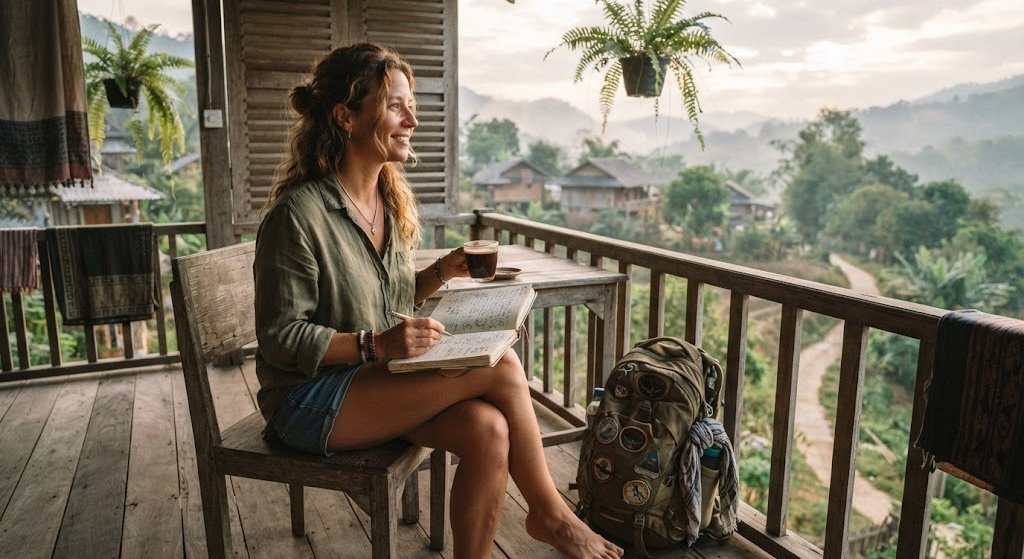
I have been watching bamboo structures across Southeast Asia for about a decade of travelling, long enough now that I notice when a material is used well and when it is only used. The first things I ever noticed were not buildings at all: a baby carrier woven from thin strips, and a table made by turning a basket upside down. Small solutions, no instructions, all of them about balance and using what grows nearby.
A scaffold tied by hand in Hong Kong
The clearest example I have seen is a bamboo scaffold on a side street in Hong Kong, going up beside a concrete block that had been there for years. It is light, flexible and tied at every crossing with strips of plastic, and it moves slightly in wind the way a rigid frame never does. I stood across the road for ten minutes watching a worker climb it, and the precision of the knots impressed me more than the finished tower behind it.
Old technique, current city. The scaffold is not a display piece; it is rented, taken down and put up again on the next job, and the economics only work because the material is fast to cut and light to carry up.
A restaurant made of it in Sri Lanka
On the coast I ate lunch in a place built almost entirely from bamboo. The tones were soft, the roof filtered the sun into stripes on the floor, and the open sides let the sea breeze do the cooling. There was no air conditioning and none was needed, which is the part I keep coming back to when someone tells me that green building means buying better equipment.
Why the material has not changed
Bamboo grows fast, works with hand tools, and needs almost nothing in transport when it is used near where it grows. It has not changed much in thirty years, and that is arguably its strength: it does not depend on a supply chain staying stable. When I plan a trip around slow travel and simple stays, the buildings that suit me are the ones that behave the same way.
There are limits worth knowing before anyone gets romantic about it. Untreated bamboo rots if it sits in damp ground, so the feet of every post are set on stone or lifted off the soil; insects are a real problem, which is why the pieces used structurally are usually treated or picked at the right age; and the joints are the weak point, checked and re-tied rather than welded. The craft is in those three details, and where they are done badly the structure does not last a decade.
I asked a builder on the coast how often the ties are replaced. Once a year before the wet season, he said, and the cost is a day of a helper's time. Compare that with a steel frame that needs a specialist and a crane, and the economics explain the tradition better than any nostalgia does.
What I look for now
Three things, every time: is the structure repairable with local hands, does it need power to stay comfortable, and will it still work in twenty years without special parts. Bamboo passes all three when it is detailed honestly and fails as soon as it is used as decoration.
What it costs to stay somewhere simple
The places built this way are also the cheap ones, which is not a coincidence. A bamboo guesthouse on the coast charged me the equivalent of nine euros for a dorm bed and fifteen for a room, with a fan rather than air conditioning and a shower that warmed itself from the sun by late afternoon. The roof did the cooling, and the only electricity after ten in the evening was the strip light over the shared table.
I stayed four nights and cooked twice in the open kitchen, which cost about two euros a meal: rice, whatever the market had, chilli paste from a jar that had been refilled so often the label was gone. Eating in is the difference between a week and a month on the same budget, and buildings like this make it easy because the communal space is where the house is designed to be.
Transport is the other half. The bus along the coast ran every hour and cost less than a coffee, the stop was fifty steps from the door, and nobody needed a booking. When the structure is light, the whole settlement around it stays light too: fewer gates, fewer fees, fewer things that only work if a system is running.
Two details I copied
First, the crossed ties on the Hong Kong scaffold. I used the same lashing pattern on a tarp frame at a campsite near the coast and it held through a night of wind that flattened the tent beside it. Second, the filtered light floor in the Sri Lanka restaurant: I now hang a cheap mat under any roof that faces west, and the room drops a degree or two without a switch.
Neither trick is original, and that is the point. They came from watching how people who work with a material every day solve the same problem I would otherwise buy a gadget for.
The useful lesson for travellers is smaller than that. Look up on any construction street in Hong Kong, ask for the bamboo place on the coast, and you will see the same idea twice: use what is close, waste nothing, and let the material do what it is good at.